
- Duration
- 7D / 6N
- Max altitude
- 15,500 ft
- Difficulty
- Moderate–Difficult
- Best months
- May, Jun, Sep, Oct
- Starts from
- Dehradun
- Stay
- Hotel, Guesthouse, Tent
- Group size
- 1-20
Overview
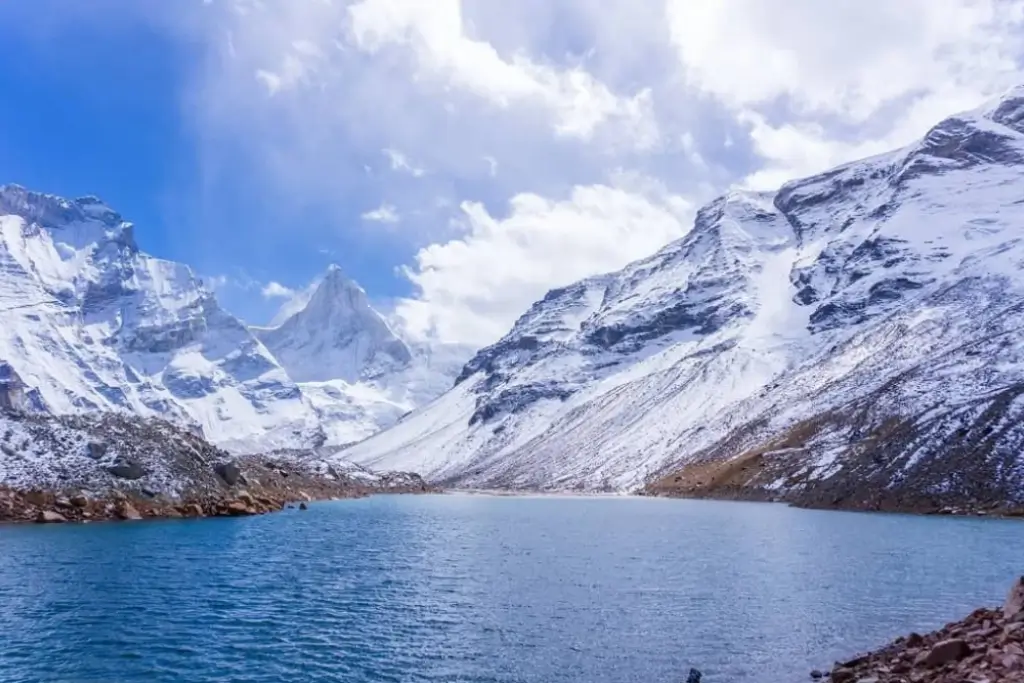
There's a lake high in the Garhwal Himalayas that locals call "Shiva's Mirror." When you finally reach Kedartal after days of climbing — through birch forests, over boulder fields, up the notorious Spider Wall — and you see Mt. Thalay Sagar's perfect pyramid reflected in its crystal-clear blue water, you understand exactly why. Kedartal sits at 15,500 feet in Uttarakhand's Gangotri National Park, and getting there is one of the most raw, demanding, and rewarding experiences on any Himalayan trail in India.
This is not a beginner trek. The trail out of Gangotri is steep from day one, altitude gain is rapid, and the rocky, technical terrain keeps you focused every step of the way. But for trekkers who've done at least one Himalayan trek and are ready to push further, Kedartal delivers something truly rare — a high-altitude glacial lake ringed by 6,000+ metre giants, with almost no one else around. Pure, quiet, and humbling
Highlights
- Shiva's Mirror — Kedartal Lake — Crystal-clear emerald water at 15,500 ft, perfectly reflecting Mt. Thalay Sagar. Few lakes in India look like this. None feel quite like this.
- The Spider Wall — A short but thrilling rock face you climb using hands and feet. It's the moment the trek shifts from a walk into a real adventure.
- Giants at Every Turn — Mt. Thalay Sagar (6,904 m), Bhrigupanth (6,772 m), Meru, and the Jogin group surround you from Kedar Kharak onwards. You don't just see them — you camp in their shadow.
- Bhojpatra Forests & Open Meadows — The trail transitions from ancient birch forests (India's own "silver forest") to high alpine meadows in just a day. The contrast is stunning.
- Gangotri as Your Base — The trek starts from one of Hinduism's most sacred towns. The evening Ganga aarti at Gangotri Temple, with the roaring Bhagirathi below, is an experience on its own.
Day by day
D1 Dehradun to Gangotri
D2 Acclimatization Day at Gangotri
D3 Gangotri to Bhoj Kharak
D4 Bhoj Kharak to Kedar Kharak
D5 Kedar Kharak to Kedartal and Back
D6 Kedar Kharak to Gangotri
D7 Gangotri to Dehradun
What’s included
- Accommodation throughout (twin-sharing tents on trail, guesthouse at Gangotri)
- All meals during the trek (vegetarian + eggs)
- Experienced, certified trek leader
- Support staff and mules for kitchen and camp equipment
- Camping gear (tents, sleeping bags, mattresses)
- Gangotri National Park forest permit
- Medical fitness certificate processing support
- First aid kit, pulse oximeter, and emergency oxygen cylinder
- Transport: Dehradun to Dehradun (pickup and drop)
- Emergency evacuation support
- Travel to/from Dehradun
- Personal trekking gear (boots, backpack, trekking poles, gaiters, etc.)
- Bag offloading charges (if needed — ₹400–₹600 per bag per day)
- Personal travel insurance (strongly recommended)
- Meals outside the trek itinerary
- Personal medicines and toiletries
- Tips for guides and support staff
- Anything not mentioned under Cost Includes
Good to know
Kedartal is a 7-day trek covering approximately 32 km return, starting and ending at Gangotri (3,100 m) in Uttarkashi district, Uttarakhand. The highest point is Kedartal Lake at 4,912 m (16,115 ft). The difficulty is rated moderate to difficult — and it earns that rating honestly. The trail gains altitude quickly, the terrain is consistently rocky and technical, and the Spider Wall section demands physical confidence. This is not the right trek for someone on their first Himalayan outing. You should have completed at least one prior high-altitude trek — something like Har Ki Dun or Kedarkantha — and be in good cardiovascular shape before attempting this. A medical fitness certificate is required by the Gangotri National Park authorities and most operators will help you arrange it as part of the booking process.
The best windows for the Kedartal trek are May to mid-June and mid-September to mid-October. The summer season brings melting snow, full streams, blooming wildflowers, and dramatic views — trails are accessible but can have patches of snow at higher elevations. Post-monsoon is arguably the best time: the skies are impossibly clear after the rains, the peaks look freshly washed, and the high meadows of Kedar Kharak turn golden. Avoid July and August entirely — monsoon rains make the rocky trail dangerously slippery and the risk of rockfall increases significantly. The trek also closes in winter when Gangotri Temple shuts (typically November), and reopens in May.
What sets Kedartal apart from other Uttarakhand lake treks is the sheer intimacy with the mountains. This isn't a trek where peaks stay comfortably in the distance — from Kedar Kharak onwards, Thalay Sagar, Bhrigupanth, and the Jogin group feel close enough to touch. And the lake itself is unlike anything most trekkers have seen in India: a deep, glacial blue-green, cradled in a rocky basin at 15,500 ft, still and silent, with one of the Himalayas' most striking peaks rising straight out of it. Very few trekking groups make it this way — the trail is demanding enough to keep crowds out — which means when you arrive, you often have the whole basin to yourself. That solitude, at that altitude, surrounded by those mountains, is genuinely hard to find anywhere else.
Questions
Is Kedartal trek suitable for first-time trekkers?
What is the best time to do the Kedartal trek?
Is a permit required for the Kedartal trek?
How difficult is the Spider Wall section?
How do I reach the Kedartal trek base at Gangotri?
Trekker reviews
What the batch said
No reviews yet — write the first one.
Been on this trek? Tell the next batch.
Anyone can write one, with photographs. We read every review before it goes up, so give it a day.