
- Duration
- 8D / 7N
- Max altitude
- 13,750 ft
- Difficulty
- Moderate
- Best months
- Jul, Sep
- Starts from
- Srinagar
- Stay
- Camping (twin-sharing tents) throughout the trek; guesthouse/homestay on Day 1 at Sonamarg
- Group size
- 8 – 20 members
Overview
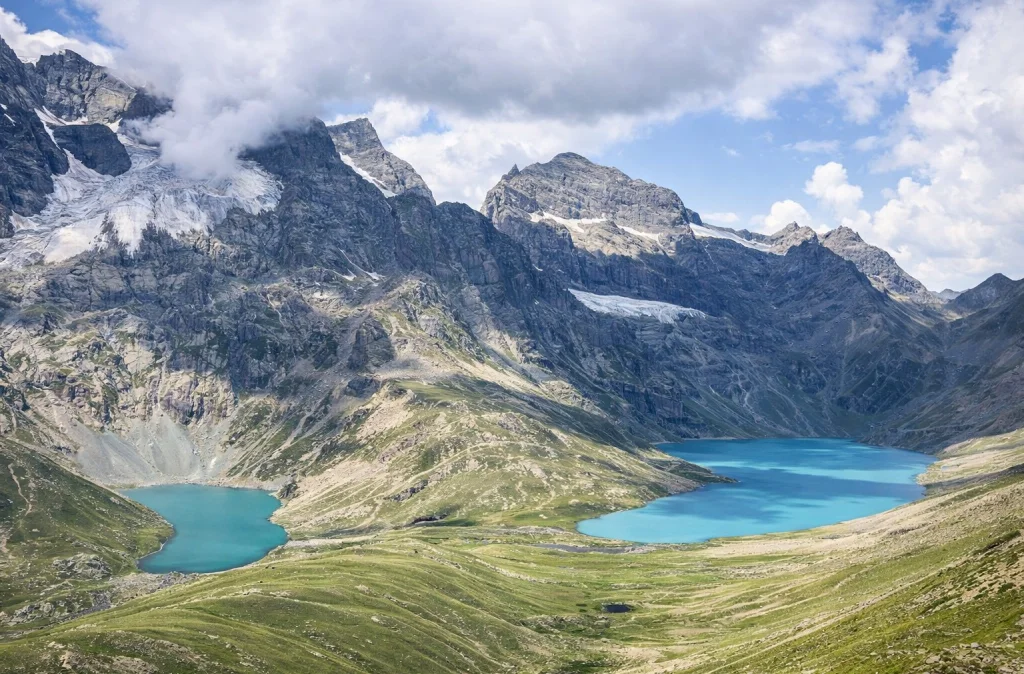
If there's one trek in India that genuinely looks like a screensaver — it's this one. The Kashmir Great Lakes trek takes you through seven high-altitude alpine lakes, five expansive valleys, and three mountain passes over 7 to 8 days, starting from Sonamarg and finishing at the ancient village of Naranag. Every lake is a different shade of blue. Every meadow is wider and wilder than the last. And the snow-capped peaks framing it all? They follow you the entire way.
This is a moderate-to-difficult trek best suited for trekkers who have some prior high-altitude experience. The daily distances are long — 10 to 15 km a day — and the terrain ranges from flower-filled meadows to rocky glacial passes. But the beauty is relentless and the variety is unmatched. If you've done a couple of Himalayan treks and want to level up to something truly extraordinary, KGL is the one.
Highlights
- Seven Stunning Alpine Lakes in One Trek — Vishansar, Krishansar, Gadsar, Satsar, Gangabal, Nundkol — each one a different hue, each one more dramatic than the last. You can't get this kind of lake-hopping anywhere else in India.
- The Gadsar Pass at 13,750 ft — The highest point of the trek, where Vishansar and Krishansar Lakes lie below you on one side and the flower-filled Gadsar Valley opens up on the other. Pure spectacle.
- Wildflower Meadows That Go On Forever — Kashmir's high meadows in July and August are blanketed in wildflowers. You'll cross five distinct valleys, each with its own personality and color palette.
- Mt. Haramukh Views from Gangabal Lake — The twin lakes of Gangabal and Nundkol sit right at the base of the sacred Mt. Haramukh (5,300 m). The reflection of the peak in the lake is one of the most iconic views on any Indian trek.
- Kashmir Culture En Route — You'll pass through Kashmiri shepherd camps (dhokas) and interact with Bakarwal nomads — a rare cultural window that most Himalayan treks don't offer.
Day by day
D1 Srinagar to Shitkadi/Sonamarg Drive: ~80 km | 3–4 hrs | Altitude: 2,610 m
D2 Sonamarg to Nichnai Trek: ~12 km | Altitude: 3,505 m | 6–7 hrs
D3 Nichnai to Vishansar Lake Trek: ~10 km | Altitude: 3,780 m | 6–7 hrs
D4 Vishansar to Gadsar Trek: ~12 km | Altitude: 3,960 m | 7–8 hrs
D5 Gadsar to Satsar Trek: ~12 km | Altitude: 3,720 m | 6–7 hrs
D6 Satsar to Gangabal Lake Trek: ~13 km | Altitude: 3,570 m | 6–7 hrs
D7 Gangabal to Naranag, Drive to Srinagar Trek: ~13 km | Drive: ~2 hrs |Altitude drops to 2,380 m | 5–6 hrs trek
D8 Departure from Srinagar Buffer/Departure Day
What’s included
- Accommodation throughout (twin-sharing tents on the trail, guesthouse/homestay in Sonamarg/Gangotri)
- All meals during the trek (vegetarian, nutritious Himalayan-style menu)
- Experienced, certified trek leader
- Support staff, porters, and horses for kitchen and camp logistics
- Camping gear (tents, sleeping bags rated to -10°C, mattresses)
- All necessary forest and national park permits
- First aid kit, pulse oximeter, and emergency oxygen cylinder
- Transport: Srinagar to Srinagar (pickup and drop)
- Emergency evacuation support
- Travel to/from Srinagar
- Personal trekking gear (boots, trekking poles, rain gear, backpack, etc.)
- Bag offloading charges (approx. ₹4,000–₹4,500 for the full trek if booked in advance)
- Personal travel insurance (strongly recommended)
- Meals outside of the trek itinerary
- Personal medicines and toiletries
- Any costs incurred due to early exit, medical evacuation, or weather-related extensions
- Tips for guides and support staff
- Anything not mentioned under Cost Includes
Good to know
The Kashmir Great Lakes trek covers approximately 70–75 km over 7 active trekking days, starting from Sonamarg (2,610 m) and ending at Naranag (2,380 m). The highest point is the Gadsar Pass at 4,191 m (13,750 ft). The trek is rated moderate to difficult — not because of any single brutal day, but because of the sustained effort required. You're covering 10–15 km daily at altitude, crossing three mountain passes, navigating rocky glacial terrain, and dealing with Kashmir's unpredictable mountain weather. Prior experience on at least one or two Himalayan treks is strongly recommended. Good cardiovascular fitness is non-negotiable — trekkers who can jog 4 km in under 35 minutes are generally well-prepared.
The only window to do this trek is July to mid-September, and this is one of those rare cases where trekking during the monsoon is actually a feature, not a bug. While most of India's mountains are shrouded in cloud and rain, Kashmir's geography keeps the Great Lakes trail largely protected from the worst of the monsoon. July brings the lakes to their fullest, the meadows to their most vivid green, and the wildflowers to peak bloom. August is the sweet spot — stable weather, crystal-clear lakes, and long trekking days. September sees the meadows turn golden and the skies turn impossibly clear, though temperatures start dropping at night. This narrow season also means permits and batch slots fill up fast — booking early (ideally 2–3 months ahead) is essential.
What makes KGL unlike any other trek in India is pure, relentless, accumulated beauty. Most great treks have one showstopper moment. This one has seven — one for each lake. And between those lakes, you get wildflower valleys, ancient shepherd trails, glacial passes with panoramic views, and the kind of open Himalayan sky that makes you feel very small in the best possible way. The trek also carries a quiet spiritual undertone — Vishansar is associated with Lord Vishnu, Krishansar with Lord Krishna, and Gangabal with the Ganga itself. You don't need to be religious to feel it; the scale and silence of these places do something to you regardless. For trekkers who want to understand why Kashmir is called Paradise on Earth — this is the trail that answers that question most completely.
Questions
Is the Kashmir Great Lakes trek suitable for beginners?
What is the best time to do the Kashmir Great Lakes trek?
How many lakes do you see on the Kashmir Great Lakes trek?
Is it safe to trek in Kashmir?
How do I reach the Kashmir Great Lakes trek base?
Trekker reviews
What the batch said
No reviews yet — write the first one.
Been on this trek? Tell the next batch.
Anyone can write one, with photographs. We read every review before it goes up, so give it a day.