
- Duration
- 8D / 7N
- Max altitude
- 14,640 ft
- Difficulty
- Difficult
- Best months
- May, Jun, Sep, Oct
- Starts from
- Dehradun
- Stay
- Homestay, Tents
- Group size
- 1-20
Overview
Some treks take you to beautiful places. Gaumukh Tapovan takes you to a place where the Himalayas feel genuinely sacred. Starting from the ancient temple town of Gangotri in Uttarakhand, this trek leads you to Gaumukh — the glacier snout where the River Ganga begins its journey to the plains. From there, you climb higher into Tapovan, a vast alpine meadow that sits at the very base of Mt. Shivling. For centuries, sages have meditated here. The moment you arrive, you understand why.
At 14,640 feet, this is not a casual trail — it involves glacier moraine crossings, steep climbs, and multiple days above 12,000 feet. Prior Himalayan trekking experience is strongly recommended. But for those who are ready, Gaumukh Tapovan offers something few treks in India can match: raw Himalayan grandeur combined with a spiritual depth that stays with you long after you're back home.
Highlights
- Stand at the Source of the Ganga — Gaumukh is where the holy Bhagirathi River gushes out from beneath the glacier. It's a moment that hits differently — spiritually, visually, and physically.
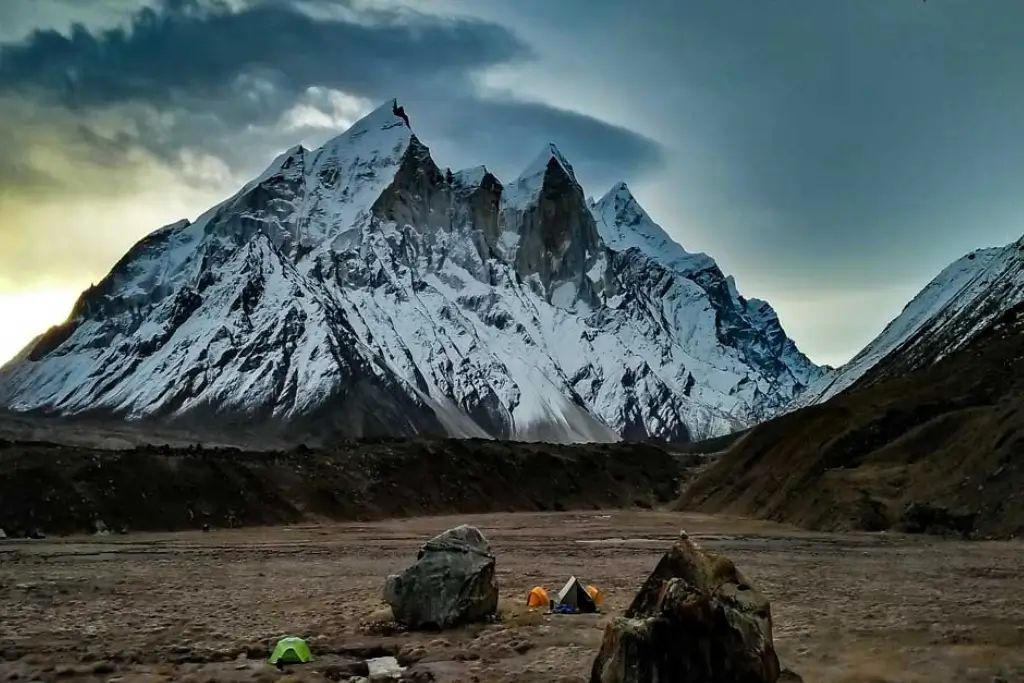
- Mt. Shivling Up Close — From Tapovan, the pyramid-shaped Shivling (6,543 m) towers right above your campsite. At sunrise, it turns gold. It's the kind of view that photographers fly halfway across the world for.
- Camp in One of the Himalayas' Most Sacred Meadows — Tapovan has been a meditation ground for sadhus and spiritual seekers for centuries. Camping here, surrounded by giants, is quietly life-changing.
- Glacier Moraine Adventure — The crossing from Gaumukh to Tapovan over the Gangotri Glacier moraine is unlike anything on a standard Himalayan trek — boulders, ice, and raw mountain energy all at once.
- Gangotri National Park Wildlife — Bharal (blue sheep) are a common sighting on the trail. On a lucky day, snow leopard tracks have been spotted near the high meadows.
Day by day
Route drawn from 4 camp locations in OpenStreetMap over SRTM elevation data. Indicative only — not for navigation. 1 camp is not mapped yet, so it has no pin.
D1 Dehradun to Gangotri
D2 Acclimatization Day at Gangotri
D3 Gangotri to Chirbasa
D4 Chirbasa to Bhojbasa
D5 Bhojbasa to Tapovan via Gaumukh
D6 Exploration Day at Tapovan
D7 Tapovan to Bhojbasa via Gaumukh
D8 Bhojbasa to Gangotri, Drive to Dehradun
What’s included
- Accommodation throughout (twin-sharing tents on the trail, guesthouse stays at Gangotri)
- All meals during the trek (vegetarian + eggs)
- Experienced, certified trek leader
- Support staff and mules for kitchen and camp equipment
- Camping gear (tents, sleeping bags, mattresses)
- Gangotri National Park forest permit
- First aid kit, pulse oximeter, and emergency oxygen cylinder
- Transport: Dehradun to Dehradun (pickup and drop)
- Emergency evacuation support
- Travel to/from Dehradun
- Personal trekking gear (boots, backpack, trekking poles, gaiters, etc.)
- Bag offloading charges (if needed — ₹400–₹600 per bag per day)
- Personal travel insurance (strongly recommended)
- Meals outside of the trek itinerary
- Personal medicines and toiletries
- Entry fees to Gangotri Temple or any local sites
- Tips for guides and support staff
- Anything not mentioned under Cost Includes.
Good to know
Gaumukh Tapovan is an 8-day trek covering approximately 46 km return, starting and ending at Gangotri (3,100 m) with the highest point being Tapovan at 4,463 m (14,640 ft). The trail runs through Gangotri National Park in the Uttarkashi district of Uttarakhand, following the Bhagirathi River upstream through Chirbasa and Bhojbasa before hitting the glacier. The difficulty is rated moderate to difficult — it's not a first-timer's trek. The glacier moraine section between Gaumukh and Tapovan is where most trekkers find it genuinely challenging: loose boulders, uneven footing, and the thin air at high altitude all add up. You'll need prior high-altitude experience, solid fitness, and the mental composure to handle a demanding summit day.
The best time to attempt Gaumukh Tapovan is May to mid-June and mid-September to mid-October. May and June bring clear skies, manageable temperatures (5°C to 18°C during the day), and the magical sight of the glacier in its most dramatic form. September and October offer post-monsoon clarity — the skies are impossibly blue, the meadows are lush, and the Bhagirathi peaks look freshly washed. Avoid July and August entirely — monsoon rains make the trail unstable and landslide-prone. Winter months (November to April) are off-limits as well; Gangotri Temple itself closes in November and reopens in May.
What makes Gaumukh Tapovan genuinely different from every other Himalayan trek is the layering. In most treks, the highlight is one specific moment — a pass, a lake, a viewpoint. Here, the highlights just keep accumulating. There's the Gangotri Temple aarti on Day 1. The first sight of the Bhagirathi peaks from Chirbasa. The emotional weight of standing at Gaumukh and realizing the entire Ganga begins right here, under your feet. And then Tapovan — where you camp in a meadow that sadhus have called home for centuries, with Shivling rising straight above you, turning from grey to amber to gold as the sun moves. It's equal parts physical challenge, spiritual experience, and pure mountain beauty, and that combination is extremely rare in the accessible Himalayan trekking world.
Questions
Is Gaumukh Tapovan trek suitable for beginners?
What is the best time to do the Gaumukh Tapovan trek?
Is a permit required for Gaumukh Tapovan trek?
How difficult is the glacier crossing on this trek?
How do I reach the Gaumukh Tapovan trek base?
Trekker reviews
What the batch said
No reviews yet — write the first one.
Been on this trek? Tell the next batch.
Anyone can write one, with photographs. We read every review before it goes up, so give it a day.