
- Duration
- 6D / 5N
- Max altitude
- 12,516 ft
- Difficulty
- Easy–Moderate
- Best months
- Jan, Feb, Mar, Apr, May, Sep, Oct, Nov, Dec
- Starts from
- Dehradun
- Stay
- Guesthouse, Homestay, Tents
- Group size
- 1-20
Overview
There is a moment on the Kuari Pass trek when the forest suddenly falls away and the entire Garhwal Himalayan range opens up in front of you — Nanda Devi, Dronagiri, Chaukhamba, Kamet, Trishul, Hathi Parbat — all at once, stretching in a 280-degree sweep that makes you forget what you were saying mid-sentence. This is what Lord Curzon came to see in the early 1900s. This is why the trail still carries his name. Located in the Chamoli district of Uttarakhand's Garhwal Himalayas, starting from Joshimath, the Kuari Pass trek winds through ancient oak and rhododendron forests, charming village lanes, and vast alpine meadows before delivering you to one of the most celebrated panoramic viewpoints in all of India.
At 12,516 feet, Kuari Pass is genuinely beginner-friendly — the ascent is gradual, the altitude gain is well-managed, and the trail is clearly defined. Yet the visual rewards are anything but beginner-level. This is the trek for someone who wants world-class Himalayan peak views without world-class difficulty, all wrapped in a 6-day journey that fits neatly into a long weekend getaway. It works brilliantly in every season — snowfields in winter, blooming rhododendrons in spring, golden meadows in autumn.
Highlights
- 280° Himalayan Panorama at the Pass — Nanda Devi, Dronagiri, Chaukhamba, Kamet, Trishul, Hathi Parbat, Changabang — all visible from one single vantage point. It's the most spectacular peak view accessible to beginners in Uttarakhand, possibly in all of India.
- The Lord Curzon Trail — A Trek with History — You're following a route explored by India's British Viceroy over a century ago. That sense of legacy, combined with the wilderness around you, adds a dimension most treks simply don't have.
- Gorson Bugyal — India's Most Beautiful Alpine Meadow — Wide, sweeping, and impossibly green in summer, blinding white in winter. Walking through Gorson Bugyal with the peaks around you is the kind of moment that ends up as your phone wallpaper for years.
- Tali Lake — A Frozen Mirror in the Mountains — A serene high-altitude lake, often frozen solid in winter, reflecting the peaks of Nanda Devi and Dronagiri in its still surface. A short but beautiful detour that most trekkers put in their top-three moments.
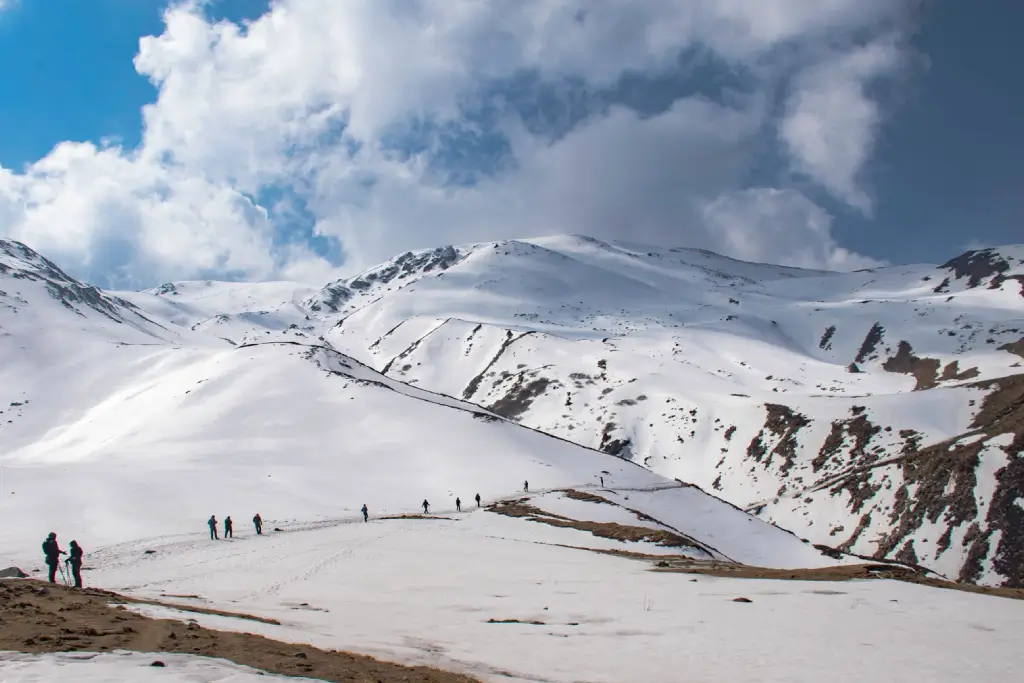
- Uttarakhand's Best Winter Trek — When most Himalayan trails close or become technical in December–March, Kuari Pass stays open and enchanting. Snow on the forests, frozen streams, white meadows — it becomes a completely different beast.
Day by day
Route drawn from 6 camp locations in OpenStreetMap over SRTM elevation data. Indicative only — not for navigation. 2 camps are not mapped yet, so they have no pin.
D1 Drive Dehradun to Joshimath
D2 Drive Joshimath to Tugasi, Trek to Gulling Top
D3 Gulling Top to Khullara
D4 Khullara to Kuari Pass & Back to Tali
D5 Tali to Auli via Gorson Bugyal, Drive to Joshimath
D6 Drive Joshimath to Dehradun
What’s included
- Accommodation throughout (guesthouse in Joshimath on Days 1 and 5, twin-sharing tents on the trail)
- All meals from dinner on Day 1 to breakfast on Day 6 (vegetarian + eggs)
- Experienced, certified trek leader
- Local support staff and mules for kitchen and camping equipment
- Camping gear (tents, sleeping bags, foam mattresses)
- Crampons and gaiters provided for snowy/icy sections
- Forest and trekking permits
- First aid kit, pulse oximeter, and emergency oxygen cylinder
- Transport: Dehradun to Dehradun (pickup and drop)
- Emergency evacuation support
- Travel to/from Dehradun or Rishikesh
- Personal trekking gear (boots, backpack, trekking poles, warm layers, rain gear, etc.)
- Shared transport Rishikesh–Joshimath (~₹1,200 per person one way, if not included)
- Bag offloading charges (~₹400–₹500 per bag per day)
- Personal travel insurance (recommended)
- Meals during road journey
- Personal medicines and toiletries
- Tips for guides and support staff
- Optional Auli cable car ride (₹750 per person approx. — pay on spot)
- Anything not mentioned under Cost Includes
Good to know
Kuari Pass Trek is a 6-day easy-to-moderate trek covering approximately 25–30 km, based out of Joshimath in the Chamoli district of Uttarakhand. The trail follows the classic Curzon Trail route: Joshimath → Tugasi → Gulling Top → Khullara → Kuari Pass (3,900 m / 12,750 ft) → Tali → Gorson Bugyal → Auli → Joshimath. The maximum altitude is Kuari Pass at 12,750 ft, with most of the trekking happening between 9,000 and 12,000 feet. Difficulty is rated easy to moderate — the trail has no technical sections, glacier crossings, or demanding river crossings. The steepest section is the final kilometre to the pass, manageable with steady pacing. Beginners with basic fitness — able to walk briskly for 4–6 hours across consecutive days — will handle this comfortably. Prior high-altitude experience is helpful but not required.
The Kuari Pass Trek works beautifully across multiple seasons but with completely different characters. Winter (December to March) is arguably the most popular window — snow covers the forests and meadows, the skies are crystal clear, and the peaks look impossibly close. This is one of very few high-altitude treks in India that remains safe and accessible through winter, which makes it especially valuable for trekkers who can only travel in the off-season. Spring (April to June) brings rhododendrons in full bloom across the trail — the forest is vivid red and pink — and the meadows begin to turn green. Autumn (September to November) offers the clearest post-monsoon skies, sharp peak visibility, and a golden quality to the light. Avoid July and August — the monsoon brings landslide risk on the roads and leech-prone trails.
What places Kuari Pass in a league of its own among beginner treks is the sheer quantity and quality of the peak views it delivers. Most beginner-friendly treks in India offer meadows or a summit moment. Kuari Pass offers both, plus forests, village culture, a sacred lake, India's most spectacular alpine meadow, and an unobstructed panorama of at least 15 named Himalayan peaks — including Nanda Devi, India's second-highest mountain — from a single point. The historical dimension adds to all of this: every step on the Curzon Trail carries the weight of over a century of Himalayan exploration. It is genuinely difficult to find another trek in India that offers so much, so accessibly, in just six days. For first-time Himalayan trekkers, Kuari Pass is not just a starting point — it is a benchmark against which every subsequent trek tends to be measured.
Questions
Is Kuari Pass Trek suitable for beginners?
What is the best time to do the Kuari Pass trek?
How do I reach Joshimath for the Kuari Pass trek?
What peaks can be seen from Kuari Pass?
What is the difference between the Kuari Pass trek and Pangarchulla Peak trek?
Trekker reviews
What the batch said
No reviews yet — write the first one.
Been on this trek? Tell the next batch.
Anyone can write one, with photographs. We read every review before it goes up, so give it a day.